
Reviewed · BUENOS AIRES WALKING TOURS
Best of Buenos Aires Private Walking Tour
Buenos Aires reveals itself through its buildings, and this private walk gives you a lively route from Florida Street to Recoleta. You’ll pass Art Deco towers, French-style palaces, old churches, a British clock tower, and the cemetery where Eva Perón is buried. The guide adds the political and family stories that turn grand façades into human drama.
I like the route’s variety, especially the shift from shopping streets and public squares to the polished avenues of Recoleta. I also like the strong local angle: the tour covers British influence, immigration, the Falklands War, Argentina’s wealthy families, and the country’s long political arguments.
The main thing to consider is the pace. This is 2.5 to 3 hours of solid walking, not a short sightseeing loop, and the full route may change because of weather, strikes, repairs, or city activity. One past guest also found the return from Recoleta inconvenient, so plan your onward transport before you arrive.
Key points at a glance
- A city-spanning route: Walk from Florida Garden near Calle Florida to La Biela in Recoleta.
- Architecture with stories: See Kavanagh, Palacio Paz, Palacio San Martín, Palacio Estrugamou, and Avenida Alvear.
- A serious history lesson: Hear about British influence, immigration, the 1982 Malvinas conflict, and the 1992 Israeli Embassy bombing.
- The cemetery is included: Allow about an hour for tombs, Evita’s memorial, sculpture, and local stories.
- A private experience: Only your group participates, with an English-speaking guide.
- Best for active sightseers: You need to be comfortable walking steadily and remaining outdoors in changing weather.
From Florida Street into Buenos Aires history
The meeting point is outside Florida Garden, at Florida 899 near the corner of Paraguay Street. Look for a small BA Walking Tours sign in the guide’s hand or on clothing, and arrive before the 10 a.m. start. The tour begins in the center and gradually works north toward Recoleta.
The first stop is Calle Florida, one of the city’s oldest shopping streets. It links the area around Plaza de Mayo with Plaza San Martín, so the guide uses it to explain how Buenos Aires grew from its founding area outward. You get commercial life, urban change, and old city stories before the grand architecture begins.
The walk then reaches the Basilica del Santísimo Sacramento. Built in 1916 for the Anchorena family, this church introduces one of the tour’s recurring themes: the influence of Argentina’s wealthy families. The guide connects the building to stories of power, marriage, family rivalry, and social position.
That approach is useful. Instead of simply hearing that a church is beautiful, you learn who paid for it and why. In Buenos Aires, money and architecture are often inseparable.
More walking tours in Buenos Aires:
- Buenos Aires Hop-On Hop-Off Bus, Free Walking Tours & Discounts
★ 4.5 · 2,218 reviews - Buenos Aires: La Boca Guided Walking Tour in English
★ 4.8 · 1,587 reviews - Nazis in Buenos Aires: a historical walking tour
★ 4.9 · 193 reviews
Kavanagh and Plaza San Martín
Edificio Kavanagh is one of the route’s strongest visual stops. The Art Deco skyscraper overlooks Plaza San Martín and was completed in only 14 months after Corina Kavanagh commissioned it in 1934. She was a wealthy woman of Irish descent who sold two ranches at age 39 to finance the building.
The story is more memorable than a basic architectural description. You see how personal ambition, old money, and city pride shaped the skyline. The building was once the tallest skyscraper in Latin America and is recognized as a UNESCO heritage building.
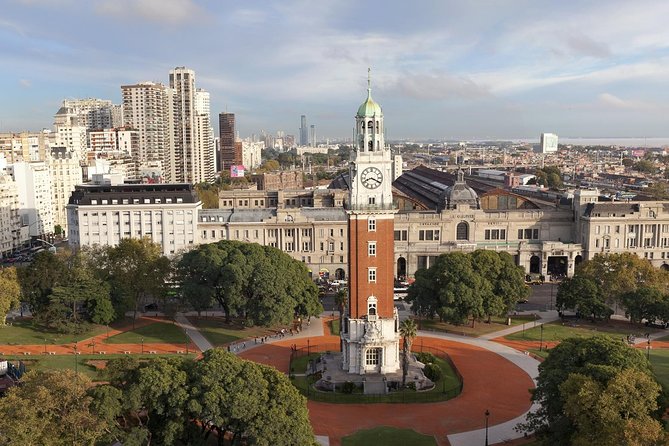
Across the area, the Torre Monumental recalls Argentina’s close ties with Britain. Once called the British Clock Tower, it points to the country’s British role in commerce, railways, livestock, and finance. Opposite it, the Monumento a los Combatientes de Malvinas brings the 1982 South Atlantic war into the conversation.
This is one of the tour’s better qualities. The guide does not present British influence as a simple footnote. You hear about Argentina’s long relationship with England, including admiration, resentment, economic dependence, and the lasting emotions tied to the Falklands, known locally as the Malvinas.
Plaza General San Martín adds another layer. The park has served as a fort site and bullring area, and it was close to old slave depots. Today, its focal point is the monument to General José de San Martín, Argentina’s leading independence figure. The guide uses the square to explain both the man and the early formation of the nation.
Palaces, churches, and the Paris of the South
The route’s grandest domestic building may be Palacio Paz. Built in 1914 for José C. Paz, a newspaper owner and political aspirant, the city palace used materials imported from France and contains 120 rooms. It was intended for a family of four, a detail that neatly captures the scale of Argentina’s upper class during its wealthiest period.
Palacio San Martín was built for the Anchorena family and later received its current political name. The guide returns to Mercedes Anchorena, whose family also funded the Basilica del Santísimo Sacramento. These connections help you see Buenos Aires as a city shaped by a small number of powerful families, not merely as a collection of attractive façades.
Palacio Estrugamou carries the French mood into Barrio Norte. Paris-style buildings and elegant streets explain why Buenos Aires earned the nickname Paris of the South. You also hear about immigration from Spain, Italy, France, Britain, and elsewhere, and how those arrivals changed the city’s language, food, architecture, and social structure.
The tour pauses at the Plaza de la Embajada de Israel, the site of the 1992 bombing that killed 24 people. This is a serious stop, and the guide covers the event, its causes, and the questions surrounding politics and justice in Argentina. It adds modern history to a walk that otherwise focuses heavily on earlier buildings.
At the French Embassy, originally the Ortiz-Basualdo Palace, the subject turns back to aristocratic society and international connections. The guide includes the story of Edward VII of England visiting with his future American wife. These small pieces of social history give the palaces some personality.
Patio Bullrich and the power of old money
Patio Bullrich is now an upscale shopping center, but its earlier life was very different. The building opened in 1867 as a British-influenced auction house for livestock, thoroughbreds, heirlooms, and collectibles. Its history shows how closely Argentina’s economy once connected to British trade and rural wealth.
I find this stop especially useful for understanding how Buenos Aires changes without erasing its past. A former auction house can become a polished mall, yet the building still carries traces of the city’s old social order.
The nearby Nunciatura Apostólica offers another look at the ties between wealth and religion. The guide explains why Argentina has an Argentine pope and how women from families such as the Anchorena and Harilaos families supported the church. Adelia Harilaos donated her palace to the Vatican, and the story gives context to the grand residence and gardens.
These stops are not just a parade of mansions. They show how newspapers, cattle, land, church donations, international ties, and political ambition all shaped the city’s appearance.
Same city, an entirely different evening:
- Buenos Aires: Piazzolla Tango Show with Optional Dinner
★ 4.4 · 2,122 reviews - Buenos Aires: City Highlights Guided Tour with Transfer
★ 4.7 · 1,946 reviews - Buenos Aires: Hop-On Hop-Off City Bus Tour
★ 4.2 · 1,855 reviews - Buenos Aires Hop-On Hop-Off Bus and Exclusive Benefits
★ 4.4 · 1,714 reviews
Recoleta, Avenida Alvear, and the route’s elegant finish
As you approach Recoleta, the mood changes. This is an affluent area of former palaces, Paris-style townhouses, boutiques, and broad streets. Avenida Alvear is the centerpiece, with lavish residences that reflect Argentina’s period of great wealth between roughly 1880 and 1930.
The guide connects these buildings to immigration and to the country’s rise and fall. That wider explanation matters because the architecture can otherwise feel like an isolated display of luxury. You learn why this level of construction was possible, who benefited from it, and how national fortunes shifted.
The Basilica de Nuestra Señora del Pilar is one of the route’s most important religious buildings. Completed in 1732 as part of the Franciscan Recoletos monastery, it is the second-oldest church in Buenos Aires. Admission is included, and the visit gives you a break from the pavement while adding colonial architecture to the tour.
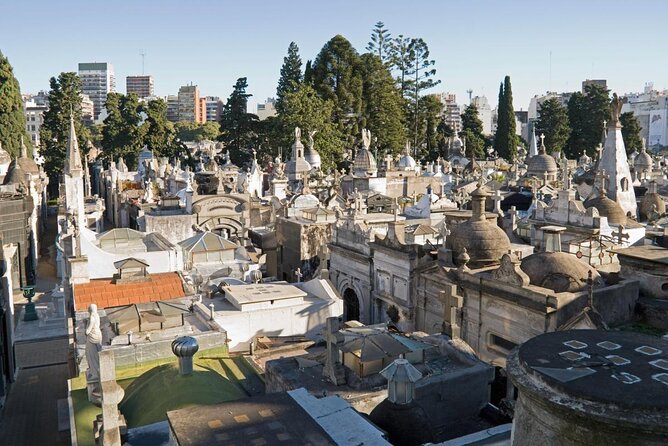
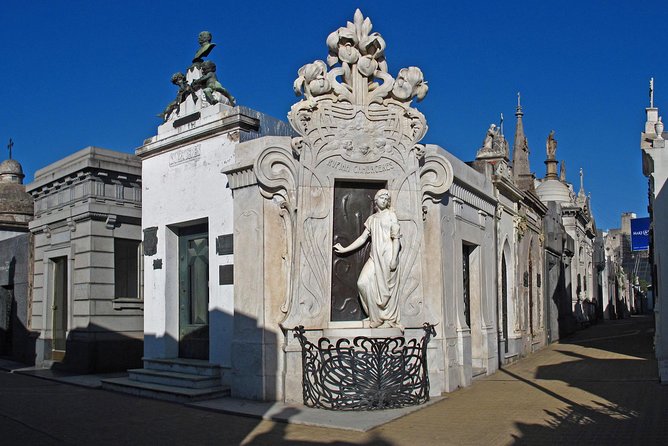
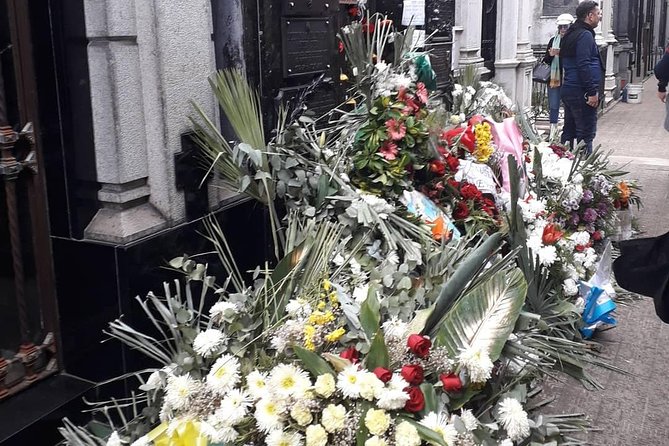
The final major stop is La Recoleta Cemetery. The planned visit lasts about an hour, though the exact coverage depends on time and circumstances. This is not treated as a quick look at Evita’s tomb. The guide discusses Eva Perón and her memorial, as well as figures such as Admiral Brown, General Guido, the wealthy Leloir family, Rufina Cambaceres, Tiburcia Domínguez, and Liliana Crociatti.
You’ll also encounter sculpture, the old monastery and cultural center, Bourdelle’s monument to Alvear, the Palais de Glace, the National Fine Arts Museum, and nearby neighborhoods and monuments when time allows. The cemetery is best understood as an open-air record of Argentina’s social structure. The grand mausoleums show who had money, influence, fame, or a place in the national story.
One practical warning: the supplied route describes an extensive cemetery visit, but one past experience ended in Recoleta without entering the cemetery. City conditions and timing can affect coverage, so ask your guide early how much time is available for the cemetery portion.
The walk finishes outside La Biela, a landmark café on Avenida Quintana. This is a useful ending because you are close to restaurants, attractions, and public transportation. You can continue exploring Recoleta on your own rather than being returned to your hotel.
What the private format adds
The tour is private, so only your group participates. That makes it easier to ask about subjects that interest you, such as architecture, Argentina’s political history, immigration, religion, or the Malvinas conflict.
Past guides named in the feedback include Martin, Carlos, and Mariano. Martin received especially strong praise for his humor, clear English, and ability to explain social, economic, and political issues. Carlos was described as amusing and well informed about Recoleta’s architecture, while Mariano was praised for showing parts of the city that were easy to miss alone.
The quality of a private walk depends heavily on the individual guide. The feedback is mostly strong, but one person felt a guide spent too much time promoting other tours and did not answer questions fully. That is worth keeping in mind, although it appears less common than the positive comments about clear English, local insight, and an easygoing pace.
The walk operates rain or shine. Wear comfortable shoes, bring water, and carry rain protection if the forecast is uncertain. You will spend much of the time outside, and there are no hotel pickups or meals included.
Is $109 a fair price?
At $109 per person, this is not the cheapest way to see Buenos Aires. Its value comes from the private format, the English-speaking guide, the long route, and the included Recoleta Cemetery admission.
I think the price makes the most sense for a first visit, a short stay, or a pair who wants context rather than a simple list of photo stops. A guide can explain the buildings while you see them, then leave you in Recoleta with enough orientation to return to places that caught your attention.
It is less compelling if you prefer to wander slowly, stop for coffee, shop, or spend long periods inside each church. The itinerary covers at least 25 attractions, and the guide has a lot to explain. You are paying for breadth and interpretation, not a relaxed half-day with extended breaks.
Children age eight and under are free when accompanied by an adult. The tour is generally suitable for most people who can manage steady walking, but the distance and pace may be tiring for anyone with mobility concerns.
Who should book this Buenos Aires walk?
Book it if you want a strong first look at central Buenos Aires and Recoleta, especially if architecture and political history appeal to you. It is also a good choice if you are uneasy about navigating a large city alone or want a guide who can explain the connections between Argentina’s buildings, families, churches, and national conflicts.
You may want a different plan if your priority is Plaza de Mayo, La Boca, tango, or a food-focused experience. This route is centered on Florida Street, Plaza San Martín, Barrio Norte, Avenida Alvear, and Recoleta. It covers a lot, but it does not try to represent every side of Buenos Aires.
I would schedule it near the start of your stay. The walk gives you a useful mental map, and the finish near La Biela makes it easy to continue into Recoleta. Just leave enough energy for the final cemetery visit and arrange your return before the guide says goodbye.
FAQ
Where does the Best of Buenos Aires Private Walking Tour start?
It starts outside Florida Garden at Florida 899, near the corner of Paraguay Street, in Buenos Aires. Look for a small BA Walking Tours sign held by the guide or attached to their clothing.
What time does the tour begin?
The meeting time is no later than 10 a.m. You should arrive early enough to find the meeting point and guide before the walk starts.
How long does the walking tour last?
The experience is listed as approximately three hours, while the main description gives about 2.5 hours. Plan on roughly 2.5 to 3 hours, depending on timing and city conditions.
Is the tour private?
Yes. Only your group participates in the activity.
Is an English-speaking guide included?
Yes. A professional English-speaking guide is included. Guides named in the tour feedback include Martin, Carlos, and Mariano.
Is Recoleta Cemetery admission included?
Yes. Cemetery admission is included in the tour price.
Does the tour include hotel pickup?
No. Hotel pickup and drop-off are not included. The tour ends near La Biela in Recoleta.
Does the tour operate in bad weather?
Yes. The tour operates rain or shine. The full route may change because of weather, strikes, repairs, riots, or other city conditions.
Can children join the tour?
Children age eight and under are free when accompanied by an adult. The walk is suitable for most people who can manage steady walking.
Just added around Buenos Aires
- Tango Show at El Querandi with optional Dinner★ 4.2 · 3 reviews
- Wine Tasting in Buenos Aires★ 4.2 · 4 reviews
- Walking Tour: Buenos Aires bookstores★ 4.3 · 12 reviews
- Private Underground Tango Immersion★ 5.0 · 31 reviews
- Velez Sarsfield Football Match★ 5.0 · 3 reviews
- Unique Tigre and Delta Private Day Cruise Navegation★ 5.0 · 3 reviews
- Tour Buenos Aires in one day on Electric Scooters★ 5.0 · 33 reviews
- Transfers from or to the airport In Argentina Your Best Choice★ 5.0 · 28 reviews
Buenos Aires Walking Tours, compared.
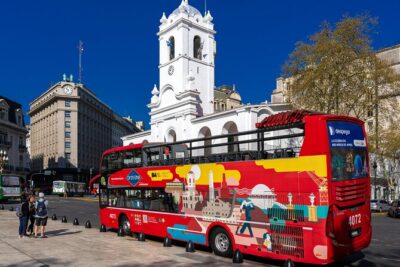
Buenos Aires Hop-On Hop-Off Bus, Free Walking Tours & Discounts
Read our review →
Nazis in Buenos Aires: a historical walking tour
Read our review →
Buenos Aires Walking Tour with Local Guide and Optional Rooftop
Read our review →
Full Day Private Walking Tour of Buenos Aires Neighborhoods
Read our review →Browse the lists this tour appears in